HUD Changed the Rules. Florida Didn’t.
If you have an emotional support animal — or you’ve been thinking about getting a letter for one — you’ve probably seen the headlines this summer and felt your stomach drop. HUD ends ESA protections. Landlords can say no now.
Here’s the calmer version, and the part most of those headlines skipped: HUD changed how it enforces. It did not change the law. And in Florida, the law that matters most to you wasn’t touched at all.
What happened on May 22, 2026
HUD’s Office of Fair Housing and Equal Opportunity withdrew its 2020 assistance-animal notice (FHEO-2020-01) along with its older 2013 ESA memo. In their place, HUD adopted an enforcement standard that mirrors the ADA’s definition of a service animal: it will pursue complaints where an animal has been individually trained to do work or perform tasks related to a person’s disability. HUD’s position is that comfort, companionship, and emotional support, on their own, don’t meet that bar — so HUD generally won’t take up those complaints itself.
That’s real, and I’m not going to soft-pedal it. If you were counting on a HUD complaint as your backstop, that door is mostly closed.
What didn’t happen
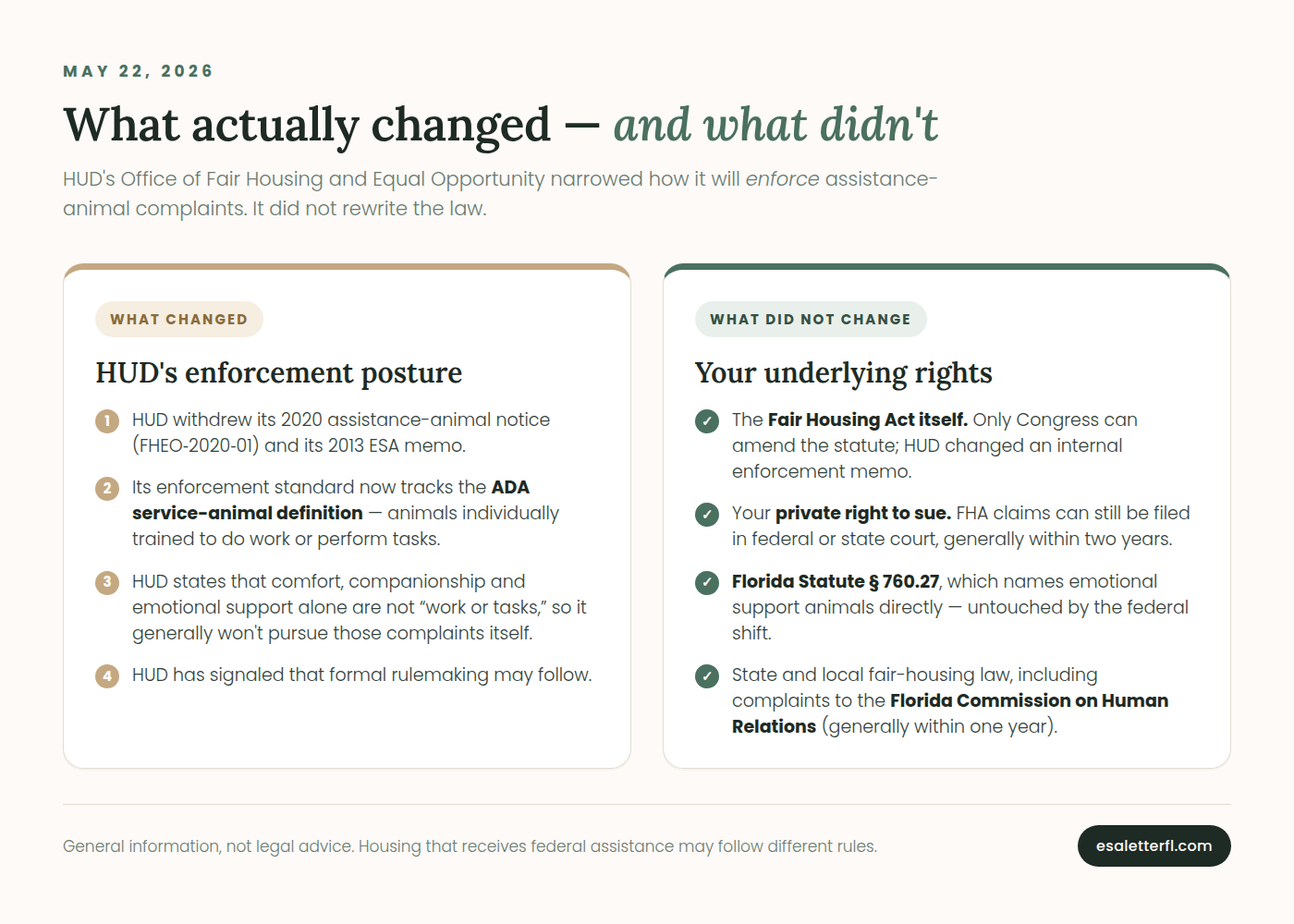
The Fair Housing Act is still the Fair Housing Act. HUD didn’t rewrite it, because HUD can’t — only Congress can amend a statute. What changed is an agency memo describing how HUD’s own staff will spend their time. Courts aren’t bound by it. If you bring a private Fair Housing Act claim in federal or state court — generally within two years — a judge reads the statute, not the memo.
And then there’s Florida.
Florida Statute 760.27 is still on the books
Florida passed its own ESA law, and it says the quiet part out loud: it is unlawful for a housing provider to discriminate against a person with a disability-related need for an emotional support animal. HUD’s federal memo doesn’t touch it. Neither does it touch your ability to file with the Florida Commission on Human Relations, generally within a year of the alleged discrimination.
The statute is also unusually specific about paperwork — and that’s where it gets interesting for anyone shopping for a letter online.
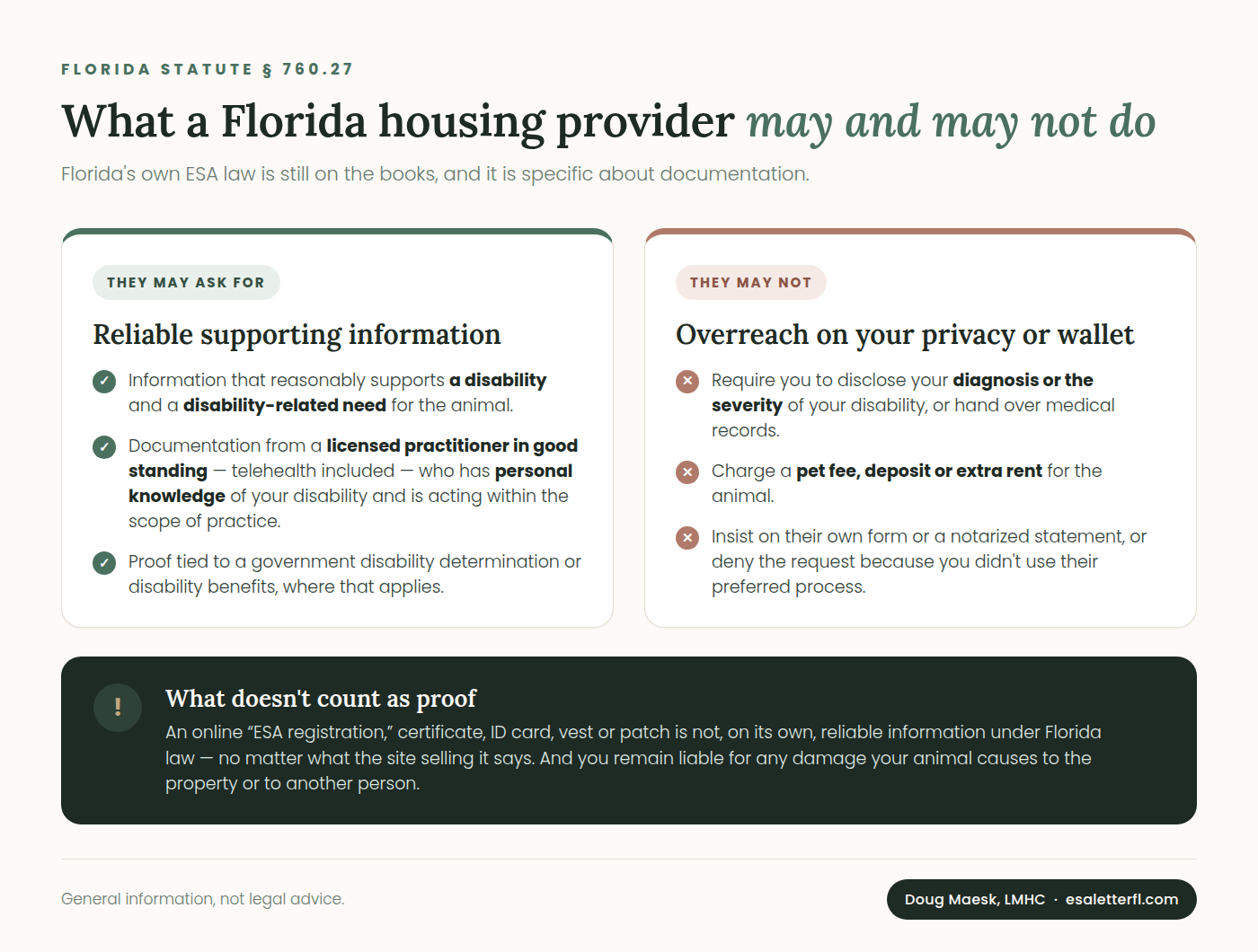
A Florida housing provider may ask for reliable information supporting your disability and your disability-related need for the animal. They may ask for documentation from a licensed practitioner in good standing — telehealth explicitly included — who has personal knowledge of your disability and is acting within the scope of their practice.
They may not demand your diagnosis, ask how severe your condition is, or require your medical records. They may not charge a pet fee, deposit, or extra rent for the animal. They may not insist you use their own form or have anything notarized.
And an online “ESA registration,” certificate, ID card, or vest? Under Florida law, that is not reliable information on its own. It never was. The sites selling them just didn’t mention it.
Why the letter itself matters more now
Here’s the practical shift. Before May, a lot of thin paperwork got through, because the federal posture was accommodating and landlords didn’t want a HUD complaint on their desk. That pressure is gone. Property managers and HOA boards in Florida have read the same headlines you have, and a fair number of them now believe they can deny anything with an animal attached to it.
They’re wrong under Florida law. But being right doesn’t help you much if your documentation falls apart on a second look.
Two phrases in the statute do all the work: personal knowledge, and within the scope of practice. A clinician who processed a web form in four minutes has neither. A clinician who actually evaluated you does.
What an evaluation here actually looks like
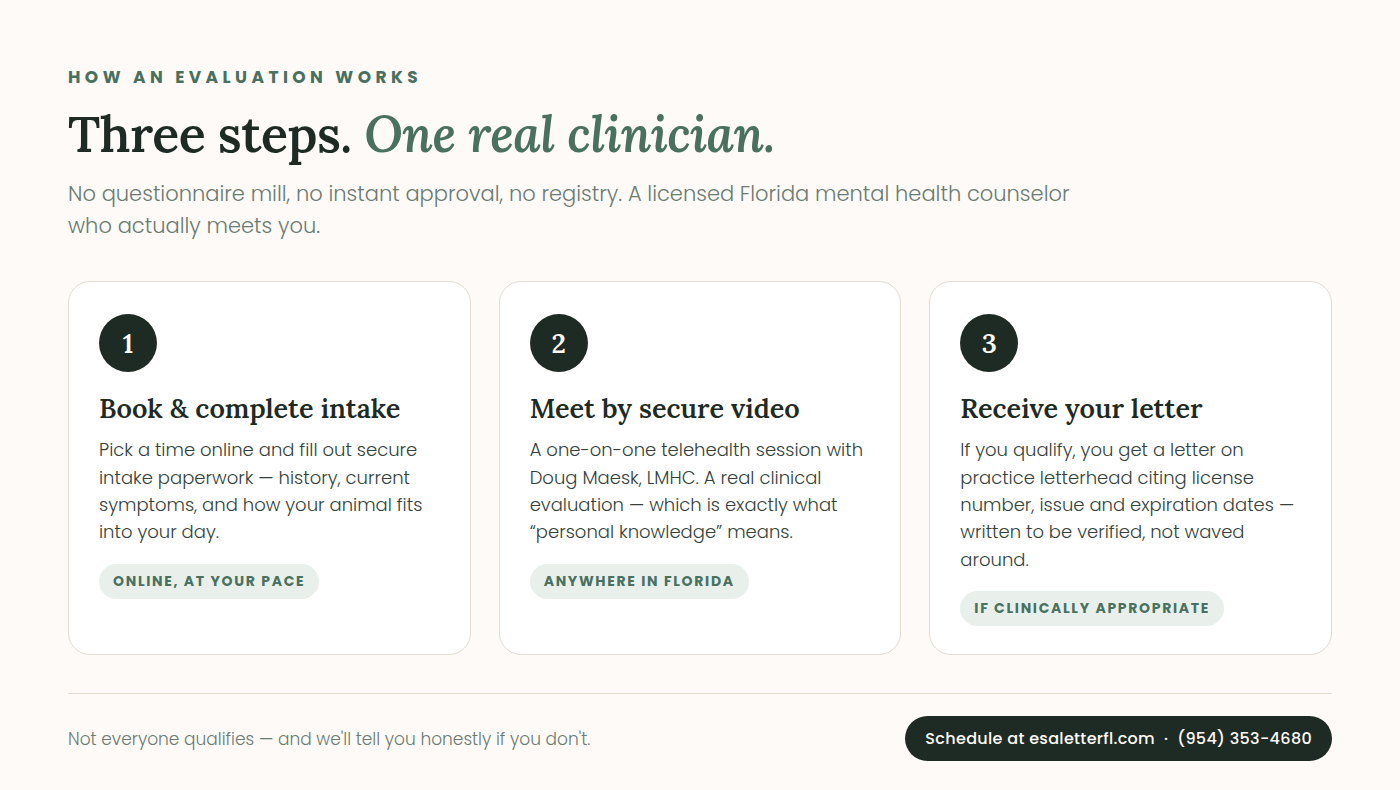
No registry. No instant approval. No “certification.” A scheduled one-on-one telehealth session with me — Doug Maesk, LMHC, licensed in Florida — where we talk about your history, your symptoms, and the role your animal plays in managing them. If the clinical picture supports it, you get a letter on practice letterhead that names my license number, its original issue date, and its expiration date, so anyone who wants to verify it can.
And if it doesn’t support it, I’ll tell you that too. A letter that can’t survive scrutiny isn’t worth what you’d pay for it.
The honest caveat
I’m a licensed mental health counselor, not an attorney, and none of this is legal advice. HUD has signaled that formal rulemaking may follow, which could shift things again. Housing that receives federal assistance may operate under different rules than a private rental. If you’re already in a dispute with a landlord or an HOA, talk to a Florida housing attorney or reach out to Disability Rights Florida.
But if what you need is a real evaluation and a letter that holds up — that part hasn’t changed at all.
Ready to start? Schedule your evaluation at esaletterfl.com or call (954) 353-4680. Telehealth, anywhere in Florida.